
At this year’s Girls’ Day, on April 25, 2024, we welcomed 20 girls to the Institute for Computer Science. They were able to participate in one of four offerings: Generative AI – creating images with Artificial Intelligence; Ant-based programming; How does a computer think?; Programming a model railroad and a ladybug. Details can be found below!
We are already looking forward to the next Girls’ Day on April 3, 2025!
How does a computer actually think?
With the online offering “How does a computer actually think?” 12 female students gained insight into computer science by writing programs in Python.
Initially, the students worked on understanding how computers think. Using a pancake recipe as an example, they realized that computers do not think for themselves but rather execute consistently provided, technical, and concrete instructions. After gaining an understanding of data types and variables, they were able to collaboratively create a computer-friendly pancake recipe.
For these practical programming experiences, the students used the website online-python.de, allowing each student to develop and execute their own programs at home without installing additional software or signing up. In the first programming round, the students implemented a calculator and learned about the concept of functions. In the next round, they learned about If-Statements and used them to develop a ChatBot that adapted its greeting to the time of day. The ChatBot was embellished with different favorite foods, hobbies, etc. For example, one student’s ChatBot had a preference for pizza, while another preferred horseback riding in their free time. In the third round, the students learned how to use libraries, that is, how to integrate existing code into their own work. With the aim of implementing a guessing game in this round. In this game, the computer thinks of a random number between 0 and 100, and the player has 5 attempts to guess the number. The students who supplemented their program with valuable guessing tips could eventually win against the computer in guessing.
In groups of two or three, the students worked with a supervisor from one of the Information Systems and Data Mining, Archaeoinformatics, and Data Science working groups in break-out rooms. This allowed the students to come into contact with computer science and gain their first successes in computer science.
Kara, the programmable ladybug, and finite automata
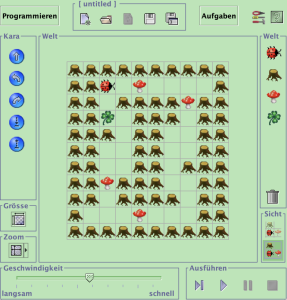 In this offering, two motivated participants delved into the world of the ladybug Kara, designing and programming it. With Kara, they completed various tasks, such as collecting clovers, walking through the world, and interacting with other objects, such as mushrooms or trees.However, Kara is not controlled using a typical programming language, as might already be familiar from class, but rather with finite automata, a very simple yet powerful computational model in theoretical computer science.
Both students quickly solved more complicated problems in the playful learning environment. For example, on the right side of the image, you can see a world where Kara takes a tour and has to find the clover. Everyone particularly liked the creativity that this environment allows. You can create your own worlds and obstacle courses for Kara and solve problems in many different ways, find new challenges, and try out directly what Kara does when the automaton is executed.
Model Railroad
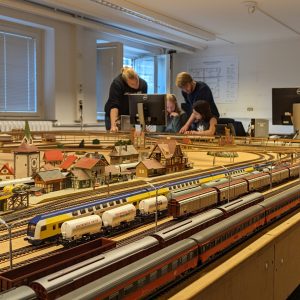
With the help of a large model railroad, the students looked at the concept of embedded and real-time systems. They quickly discovered and examined the control technology under the table. After some explanations, including why the ICE (InterCityExpress) was not connected to the rail network, they then looked at a track plan to understand which tracks are connected to which stations.
With a better overview, they then went to the computer to program the railway. First, there was a brief introduction to the railsl programming language with instructions on what to watch out for: setting switches correctly, activating all necessary track sections, and ensuring that the direction and speed are correct. The most important thing in a system with hardware that can break if misused was, of course, the simulation.
Now the students were allowed to get involved themselves. One train was already running, and they had the task of letting another train run at the same time, with a brief stop in the middle. They quickly understood the language and control of the train, and it was found that it would definitely be worthwhile to learn touch typing. After a few simulations and error corrections, the girls could admire their work and watch as both trains started simultaneously and passed each other in circles.
Generative AI – Creating Own Images with Artificial Intelligence
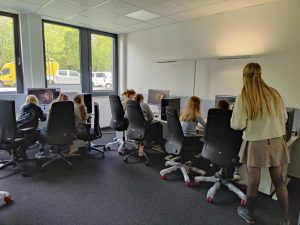
At the Girls’ Day in the Visual Computing & AI and Marine Data Science working group, the students were offered insights into the world of image processing and its diverse applications. At the beginning, they gained an understanding of the basics: What exactly is a pixel? How are colors generated using RGB? They learned that ultimately, images are interpreted as numbers by the computer and how these numbers can be used for calculation. They also explored how artificial intelligence can recognize objects based on visual features. Playfully, they approached an illustrative classification problem and supervised learning to show how artificial intelligence can be trained. Special focus was placed on understanding the process from “image to text” and vice versa from “text to image”.
The highlight of the day was undoubtedly the opportunity to use a Text2Image AI themselves, with which the students enthusiastically generated their own creative images. Finally, they wanted to know what the practical applications of what they had learned are in our everyday work. Therefore, we gave them insights into our specific application areas, such as in medicine, marine research, and wildfire simulation. This allowed us to demonstrate how diverse the application can be and what contribution it can make to important societal challenges.
Ant-based Programming
The students looked at the basics and backgrounds of ant-based programming. Using ants, complex tasks such as finding the shortest paths between many points can be solved with simple rules. With the Python programming language and the Mesa library, we let ants search for food and sort objects. We also looked at simulations of predator-prey behavior or Conway’s Game of Life together.
In a short time, the students learned basic programming concepts such as variables, loops, or conditional statements and used them directly to solve increasingly complex problems with their ants.